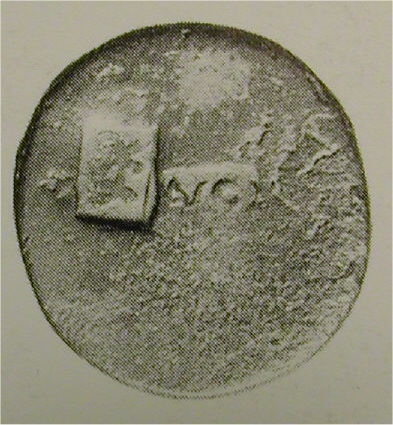
 VAR
over
TIBAVC
VAR
over
TIBAVC
 The
Museum of Roman Countermarks
The
Museum of Roman Countermarks
The Varus Debate:
in the year 9 AD, exactly 2000 years ago, the Roman military machine lost apparently 3 legions in the swamps of Germany.
Not much is archeologically confirmed though. There is a presumed battlefield at Kalriese, claiming to be "it", but without hard enough evidence. It was a battlefield alright, but one cannot even distinguish late Augustean (one of the battlefields during the Varus campaign) from Early Tiberian context (ie Germanicus), There is however a grave stone in the Bonn museum clearly confirming that there was indeed a Varus war (as has been described by various Roman historians in surviving texts).
A
countermark frequently found on
Roman copper/bronze coins in the region (VAR in ligature) has been
commonly
attributed to Varus, and is used to support the cause of Kalkriese, but
is there enough evidence to support the claim that this countermark
"VAR
in ligature" stands for Varus ?
Can the countermark VAR be assigned to Varus?
"VAR" has been proposed for many
decades to stand for
Publius Quinctilius Varus, Legatus of Germania, who lost three legions,
LEG XVII, XVIII, XVIIII, to the Germans under Arminius in
9AD.
This attribution has caused this relatively common
countermark to reach
enormous price levels (up to some 2000€s).
The location of the Varus battle site to Kalkriese near
Osnabrück
is mainly based on that assumption, as coins with "VAR" were found in
the
excavations. If VAR is not Varus, then that site could not be dated to
other than late Augustean - Tiberian time frame. The Germanicus
campaign
hypothesis assumes that Kalkriese was not the Varus battle site, but
represents
a later battle site of Germanicus' troops with the Germans in 15 or 16
AD.
| The Varus Debate: Pro | The Varus Debate: Con |
|---|---|
| "VAR" is relatively common with maybe up 500-1000 pieces known, and geographically spread over a very wide area: from Gallia to the Rhine and even into the Danube area. | |
| Varus clearly controlled more than just the legions he lost, with others stationed on the Rhine under his legate Lucius Asprenas. The widespread distribution is not unreasonable for a Legatus with at least 5 legions under his command and whose countermarked coins would have continued to circulate after his death. In addition there was substantial troop movement shortly after his death | This widespread distribution is suprising for a general who lost so heavily and whose memory was not honored. |
| "VAR" is always applied later than the "large wheel",
"IMP", and "CVAL",
but before or simultaneously to "AVC". This would be consistent with a countermark applied late during the reign of Augustus (but does not exclude Tiberius as the AVC countermark continued to be in use during his reign). |
A coin exists, in the municipal museum of Rennes, with
"VAR" applied
over "TIBAVC". "TIBAVC" (Pangerl Collection CMK 30) is a Tiberian
countermark.
This makes the Varus hypothesis very unlikely, if not impossible. The
coin
has been published in R.Martini; CAESAR AUGUSTUS in
Glaux special
series II, 2001, ENNERE, Milano), pp 193-194 (see image below)
, . |
| Varus had the authority to issue local coins. Local provinical coins were issued in Africa Proconsularis as well as in Syria, with his name in the legend and in some cases also with his bust. Since he had the authority to issue local coins, he may have had the authority to countermark imperial coins in the West also. However no such local coins exist in Gallia or the Rhine border region, while local coins issued in the name of Roman officials seem to be common in Eastern Provinces under Augustus. | A second example was recently brought to our attention.
"VAR" overstrikes
"TIB" square. "TIB" square (Pangerl Collection CMK 50) is a
Tiberian
countermark. Published in R. Martini, Collezione Pangerl, Nomismata 6,
2003, pp xlix-li.
This makes the Varus hypothesis very unlikely, if not impossible. |
| There are also countermarks in the Syrian province on local provincial coins which were attributabed to Varus, e.g. by Howgego; Greek Imperial Countermarks numbers 658 and 659 show "VAR","PVAR" and "QVAR" ligatures. These appear to be co-temporal to Varus' term of office as governor of Syria. These countermarks are quite similar in texture to the western VAR under discussion. No definite proof is possible however. | Both "TIBAVC" and "TIB" are Tiberian countermarks ("TIBAVC" known on Drusus Junior Coins of 22/23 AD). Thus, if VAR is co-temporal with Tiberius, then VAR cannot stand for Varus, as he died with his legions in Germania prior to Tiberius' assumption of power in 14AD. |
| CVAL is found in association with VAR. CVAL is theorized to be one of Varus' generals (Wolters, Germania 73 (1995), 145-150), commander of the cavalry, standing for C. Numonius Vala. CVAL is always applied before VAR, but never after. This would be consistent with a coin countermarked by Vala, which could then have circulated to other troops not associated with Vala, and could have been then countermarked by Varus' authority. Again no definite proof is possible. | |
Here the coin with VAR over TIBAVC that triggered the Varus
Debate (copyright
R. Martini, from R.Martini; CAESAR AUGUSTUS in
Glaux special series
II, ENNERE,
Milano), from the
Municipal Museum, Rennes, France.
VAR
over
TIBAVC
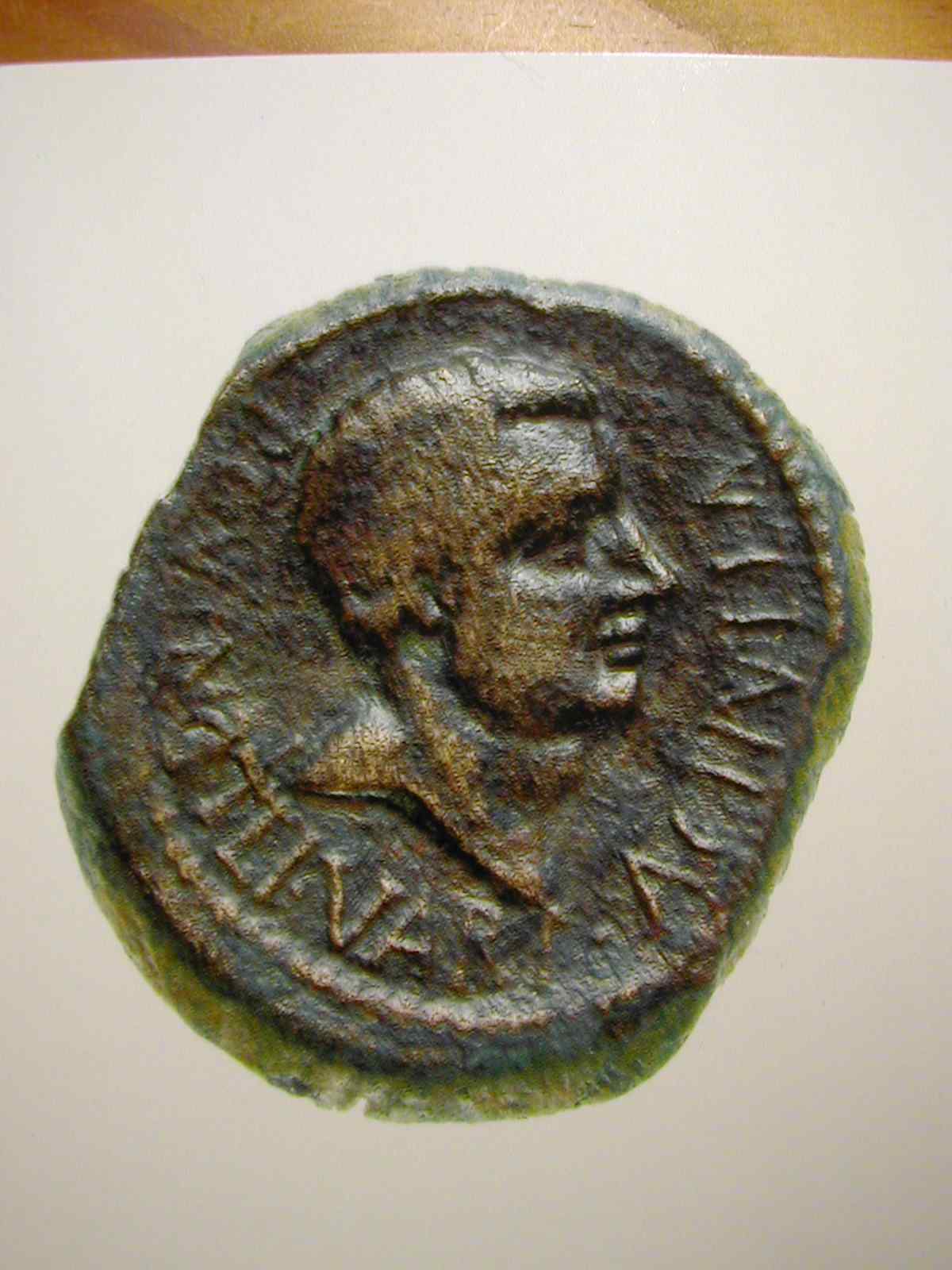
P Quinctilius Varus
as Governor of Syria
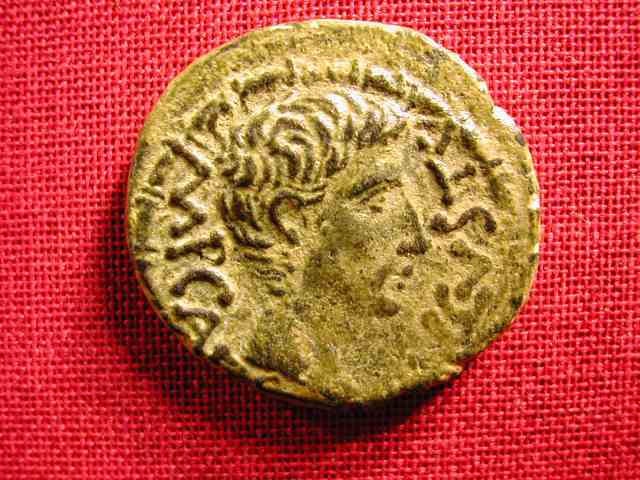
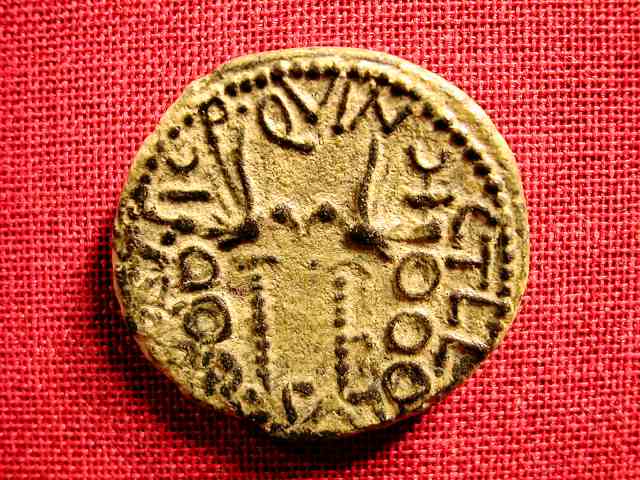
as Governor of Africa (coin with
his portrait) from the
RGZM Mainz, Germany
The Varus Battle (the end of LEG XVII, XVIII, XVIIII)
Here the only archeological artefact clearly pointing to the Varus desaster:
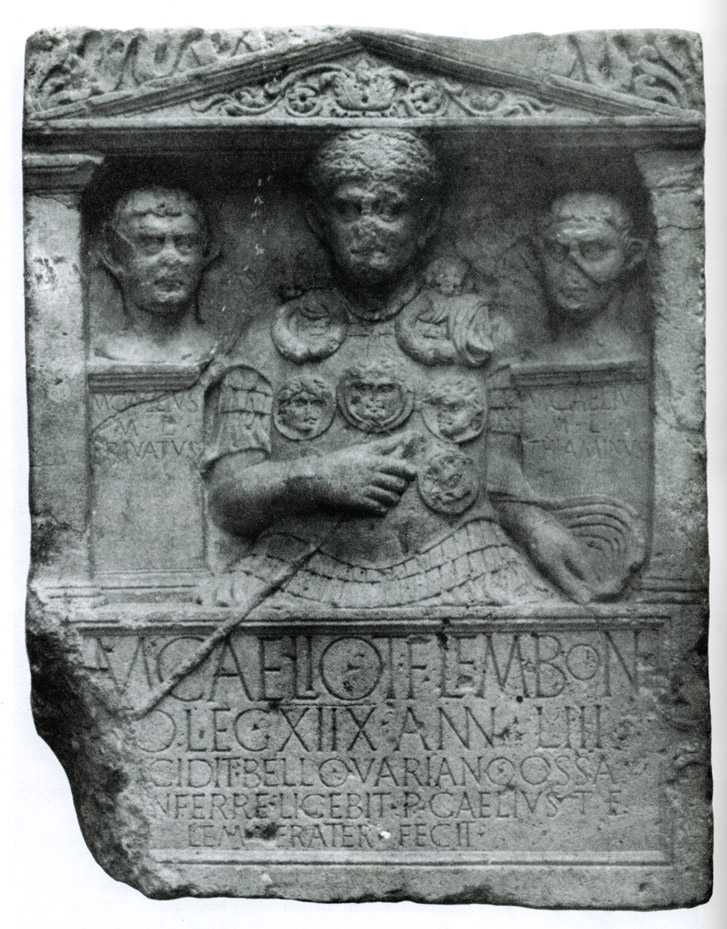
This impressive stone is now in the Bonn
Museum. The
text reads:
"To Marcus Caelius, son of Titus,
of the Lemonian voting
tribe, from Bologna, a centurion in the First Order of legio XVIII,
aged 53; He fell in the Varian War. His
bones - if found
- may be placed in this monument. Publius Caelius, son of Titus, of the
Lemonian voting
tribe, his brother, set this up."
If you want to see more of the Varus battle, here other interesting links:
To
RNG section countermarks
of Augustus
To the
Roman Numismatic Gallery
main page