 The Roman Military Museum
| |
Short Introductions for each Department:
List of Roman Legions in this Museum on Coins, Bricks, and Artefacts
Table with direct links to images of Legions mentioned on
coins, bricks,
and other artefacts.
Showing representative examples of Roman military equipment from the late Republic to the late Empire, from major museums and selected private collections.
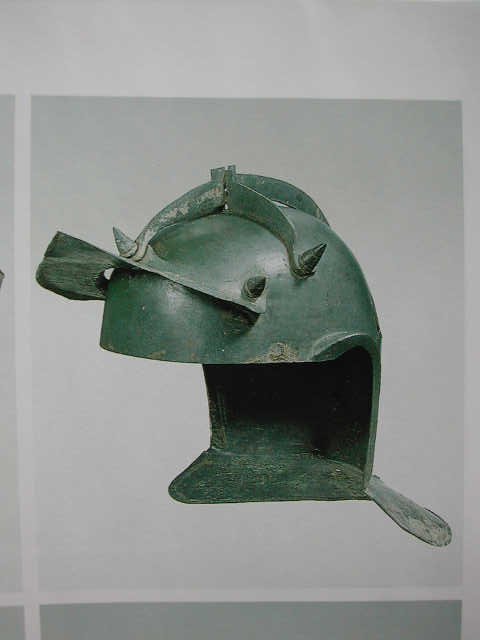 Roman
bronze helmet of the type Niederbieber, cheek pieces are missing
Roman
bronze helmet of the type Niederbieber, cheek pieces are missing
Example of a Roman Military Diploma, that granted Roman citizenship after 25 years (army) or 26 years (Navy) of military service in the auxiliary forces to the veteran and his family. Soldiers in these auxiliary forces (on foot = cohors, mixed with light cavalry = cohors equitata, cavalry = ala) were usually not Roman citizens when they joined the troops. In contrast legionaries had to be Roman citizens. This distinction lost its importance when Caracalla granted citizenship to all people living in the Roman empire (except to the slaves of course).
Mail us if you need support in identifying details of a military diploma you may have in your collection. We are publishing military diploma in major scientific journals and appreciate very much new material from private collections for this purpose. Your name can be named as donor, or you can remain anonymous, whichever you prefer.
Even small fragments can help to bring Archeology
forward !
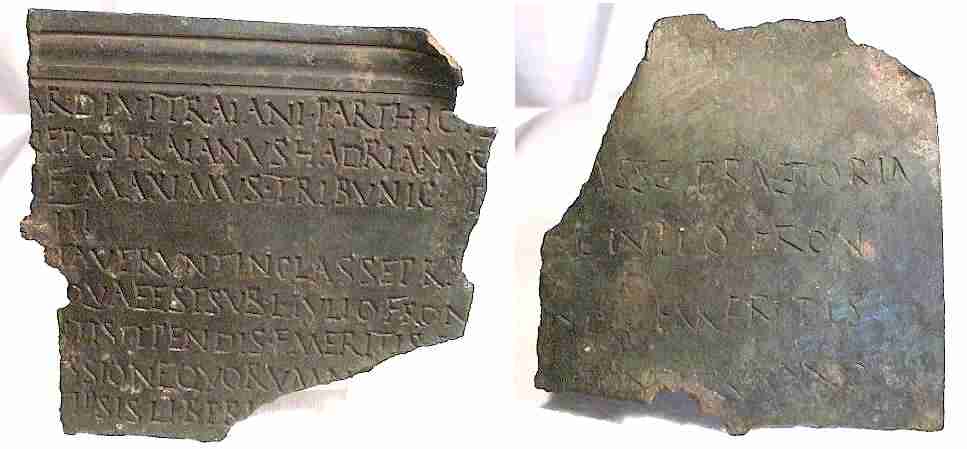
From Hadrian's reign for either the
praetorian fleet
of Misena or Ravenna (W.Eck, D.MacDonald, A.Pangerl, "Neue Diplome
Italischer
Truppen", ZPE 2002).
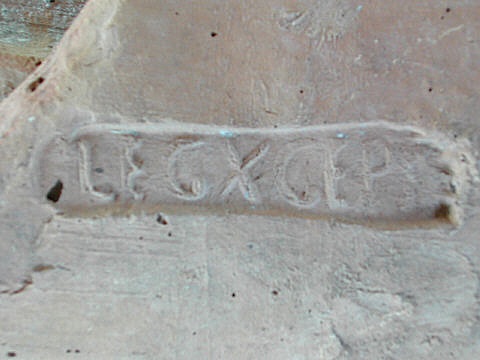
Largest collection of Roman Legionary Brick Stamps on the web
4 main groups of Roman coins are devoted to legions, the Denari of Marcus Antonius before the battle of Actium 31 BC, the Aurei, Denari and Sesterti of Septimius Severus of 193 AD to thank those troops that supported him to become emperor, the Antoniniani of Gallienus of 260/261 AD attributed to his newly formed mobile reserve off Mediolanum (Milan), and the very rare Antoniniani of Carausius minted in Londinum (London).
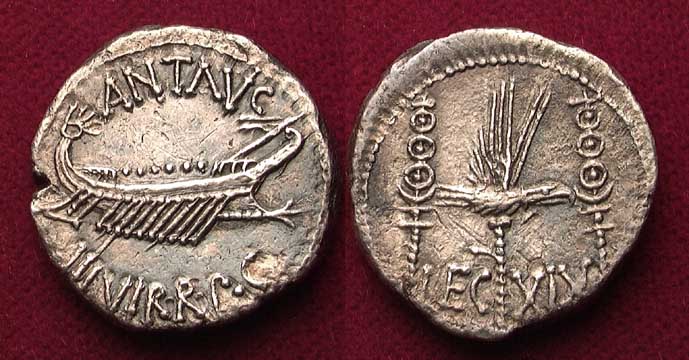
"Legio XIX" Denarius of Marcus Antonius
for his legions
before the battle of Actium, that he lost together with his lover
Cleopatra
against Octavianus, the later Augustus, grandnephew and heir of Julius
Caesar. These denarii exist for Leg II - XXIII, as well as for special
elite units such as the speculatores and the praetorian cohort. The
link
from the Denarii of Marcus Antonius to the legions of Augustus and the
later empire is very problematic and can only be made for those few
legions
that Augustus took over after the battle of Actium being old legions of
his "father" Caesar (e.g Leg XII Fulminata, Leg V Alaudae), or merged
with
his existing legions. E.g. the LEG X Equitata of Caesar - with Antonius
at Actium - was merged by Augustus into LEG X GEMINA. Most of the
legions
of Marcus Antonius were dissolved however.
In this section a detailed display of Legionary Countermarks on Roman coins is shown.
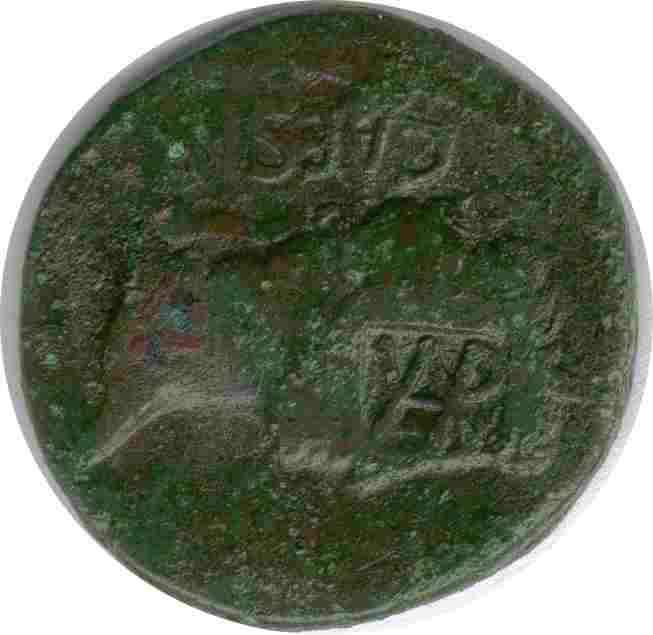 Countermark
"VAR" long thought to be of Quinctilius Varus, who died with his three
legions trapped in the deep German forests of theTeutoburger Wald in 9
AD. The numerals of the Legions XVII, XVIII, XIX lost by Varus to the
Germanic
tribes were never replaced, despite the fact that the legionary eagles
were later recovered. Many countermarks on Jilio-Claudian coins have
military
context, even though direct links are difficult to prove.
Countermark
"VAR" long thought to be of Quinctilius Varus, who died with his three
legions trapped in the deep German forests of theTeutoburger Wald in 9
AD. The numerals of the Legions XVII, XVIII, XIX lost by Varus to the
Germanic
tribes were never replaced, despite the fact that the legionary eagles
were later recovered. Many countermarks on Jilio-Claudian coins have
military
context, even though direct links are difficult to prove.
There are many roman coin designs with direct reference to the military and to wars (especially to victories - real or propaganda-. A special section of this museum covers Roman victories.
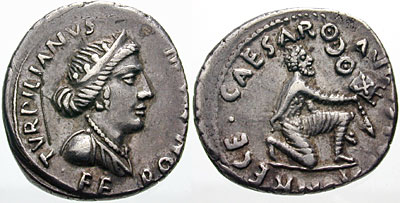 Parthian
returning the legionary standards lost by Crassus (denarius of
Augustus),
one is tempted to read a X for tenth legion on the standard.
Parthian
returning the legionary standards lost by Crassus (denarius of
Augustus),
one is tempted to read a X for tenth legion on the standard.
A late Roman road map

Locations of the Roman Legions
In this section of the museum the attempt is made to document
each legion
ever cited on a coin, and to give its main location from the period of
Vespasianus - Diocletian. One has to consider however that the legions
moved rather frequently to areas of need. A special section of this
museum
offers a table with the Location
of Roman
Legions for those interested in further details. In general
the bulk
of the roman army was based a) in the West in the Rhine region during
the
reign of Augustus, but shifted later to the Danube border, and b) on
the
Eastern frontier towards Persia.
This website is purely non-commercial. We do not capture any personal data / do not set cookies. Please note that an anonymous assessment of visitor info such as e.g. search key words and country of origin is made through statcounter.com. We hope you enjoy the visit and find the free information you need. We always look forward to feedback and suggestions to further improve the service.. Our Email is romancoins.info at yahoo.com